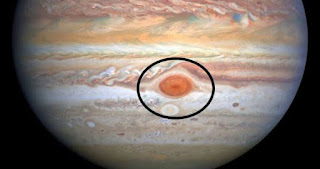
Jupiter's storm


 Jupiter is the largest planet in the solar system, which is a giant gas planet, it contains a lot of hydrogen and helium, most of it is in the gaseous state. Jupiter's mass is 317 times that of Earth, scientists say, it hardly has a rocky core, but much of its radius is taken up by metallic hydrogen, liquid hydrogen, and layers of its atmosphere.

Researchers say that if Jupiter had the same density as Earth, then its radius would be 7 times greater than that of Earth, but in reality Jupiter's radius is 11 times greater than Earth.  Jupiter is a recognizable presence of the Solar System, as it is the only planet in the Solar System whose surface atmosphere is clearly divided into turbulent bands, below its equator is the Great Red Spot, which looks like a red eye,

The Great Red Spot is an anticyclone, which revolves around a center of high atmospheric pressure, if such a storm forms on Earth, it will move in the opposite direction than Earth's storms.

The Great Red Spot, seen on Jupiter, is the largest storm in the Solar System, which is larger than Earth, with winds blowing in it hundreds of miles per hour.  The Great Red Spot was observed in 1665;  Researchers estimate that the Great Red Spot has been raging for more than 350 years, with a diameter estimated to be about 56,000 km in the late 1800s, but in 2017 NASA reported an average width of 16,000 km, the researchers said.  That is to say, the Great Red Spot is gradually shrinking over time.

Hubble detected a new storm in 2020 from its snapshot, which scientists call a cousin of the Great Red Spot, which changed its color.  The planet is also observed by Hubble in multiple wavelengths, to give researchers insight into the height and distribution of the planet's haze and particles, to complement visible-light imagery, which captures ever-changing cloud patterns.  it shows. Hubble is exploring the Jupiter archive to learn more about Jupiter.

Comments

Popular posts from this blog

James Webb Space Telescope Opens New Frontiers in the Search for Life Beyond Earth.

  This image illustrates a science-based artist’s impression of K2-18 b, a potentially habitable exoplanet 120 light-years away, orbiting a cool dwarf star in its habitable zone. NASA’s James Webb Space Telescope (JWST) is revolutionizing the search for life beyond our solar system, offering humanity its most detailed look yet at distant, potentially habitable worlds. With its extraordinary infrared capabilities, Webb is not only detecting atmospheres on small rocky exoplanets but also probing their chemical makeup in search of biosignatures—clues that could hint at the presence of life. However, scientists caution that context is everything. Atmospheric data alone is not enough to confirm life; understanding a planet’s surface, interior, and broader environment is essential. Even detecting a potential biosignature, such as a gas possibly produced by biological processes, doesn’t equate to discovery. Multiple, independent lines of evidence would be needed to confirm such a find. “F...

Webb Telescope Reveals Tangled Rings and Dusty Chaos in Dying Star System NGC 1514.

  NASA’s James Webb Space Telescope has captured the most detailed image yet of planetary nebula NGC 1514, revealing clumpy dust rings and clear holes in its vibrant pink core using mid-infrared light. A dying star’s final performance has been brought into sharp focus by NASA’s James Webb Space Telescope, revealing a cosmic display of tangled rings, drifting dust, and mysterious holes in the planetary nebula NGC 1514. This mesmerizing structure lies about 1,500 light-years away in the constellation Taurus and has been evolving for at least 4,000 years. At the heart of the nebula are two tightly bound stars, orbiting each other every nine years, their light diffracted in Webb’s images like a celestial jewel. While the stars appear as one in mid-infrared light, they are central to the nebula’s complex architecture. One of these stars, once several times the mass of our Sun, ejected its outer layers in a slow, dense stellar wind as it aged. The other star’s close approach may have twi...

Astronomers have discovered a 'Death Star' black hole in action.

A team of astronomers has studied 16 supermassive black holes that are firing powerful beams into space, tracking where these beams, or jets, are pointing now and where they were aimed in the past, as reported in our latest press release. Using NASA’s Chandra X-ray Observatory and the U.S. National Science Foundation (NSF) National Radio Astronomical Observatory’s (NRAO) Very Large Baseline Array (VLBA), they found that some of the beams have changed directions by large amounts. These two Chandra images show hot gas in the middle of the galaxy cluster Abell 478 (left) and the galaxy group NGC 5044 (right). The center of each image contains one of the sixteen black holes firing beams outwards. Each black hole is located in the center of a galaxy embedded in the hot gas. In the images below, labels and the radio images appear. Ellipses show a pair of cavities in the hot gas for Abell 478 (left), while ellipses indicate two pairs of cavities for NGC 5044 (right). These cavities were carve...